
Clematis
 | Origin Temperate climate zones of the northern hemisphere, distributed worldwide | |
 | Family Ranunculaceae | |
 | Flower Spring to fall | |
 | Sunny to partial shade |
Origin:
Clematis, also known as woodbine, belongs to the buttercup family (Ranunculaceae) and is found worldwide, especially in temperate climates in the northern hemisphere. There are around 300 species native to various regions of Europe, Asia, and North America.
Growth:
Clematis are perennial climbing plants that can grow to different heights depending on the species and variety, usually between 2 and 12 meters. They climb up supports with the help of leaf stalks or stems and can cover walls, fences, pergolas, and trees. Some varieties grow as bushy perennials.
Leaves:
The leaves of clematis are opposite and vary greatly in shape and size, depending on the species. They can be simple or compound, ovate, lanceolate, or lobed. The color ranges from light to dark green, and the leaves can be smooth or slightly hairy.
Flowers:
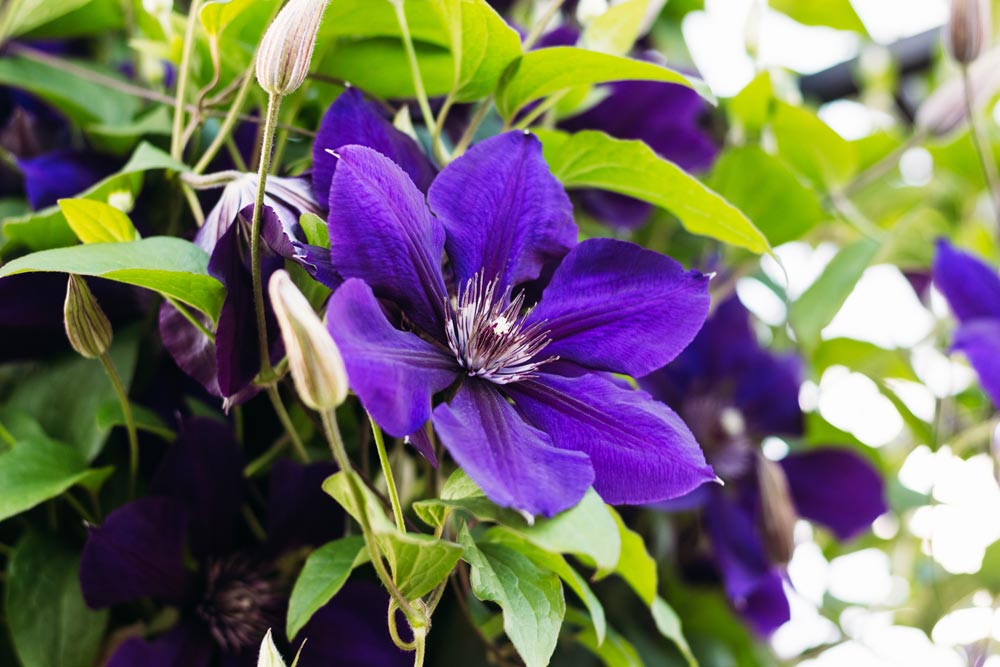
The flowers of clematis are the main attraction and come in a variety of shapes, sizes, and colors. They can be single or double, with diameters ranging from 2 to 25 cm. Flower colors include white, pink, red, blue, purple, and yellow. Flowering time varies depending on the variety and ranges from spring to fall. Some species bloom twice a year.
Location:
Clematis prefer a location with sunny to semi-shaded conditions. The plants like their roots to be cool and shady, while the upper parts of the plant receive sufficient sunlight. A well-drained, humus-rich soil is ideal. Clematis should be planted so that the base of the plant remains in the shade, often using mulch or low-growing plants.
Care:
Clematis need regular care to stay healthy and bloom profusely. They should be watered regularly, especially during dry periods. A layer of mulch helps to retain soil moisture and keep the roots cool. Clematis benefit from annual fertilization in spring with a balanced, organic fertilizer. Pruning varies depending on the clematis group (spring-flowering, summer-flowering, fall-flowering) and is important for flowering and plant health. It is also advisable to check the plants for pests and diseases, such as clematis wilt and aphids, and treat them accordingly.
Discover our range of flowers
We deliver to every private address, every business or office, every hospital or rehabilitation clinic, and of course every retirement and nursing home in Switzerland. Whether you want a bouquet, a flower arrangement, or roses.
We also have a special range for special occasions such as: